I've Been Running a Business for 35 Years. Nothing Prepared Me for This.
How curiosity, a university collaboration and two AI assistants are changing the way we work.
I never imagined that, at this stage of my working life, I'd find myself waking at three in the morning, not because I was worrying about the business, but because I couldn't wait to explore another idea.
That's what artificial intelligence has done to me.
I've spent 35 years running Janitorial Express and seen plenty of technological developments come and go. Some have been genuinely transformative. Others have promised considerably more than they delivered.
But this feels different.
I'm not a programmer. I have no background in computer science and, until recently, I wouldn't have dreamt of trying to develop software myself. Yet over the past few months, I've found myself doing things I wouldn't previously have thought possible.
And perhaps the biggest surprise is how much I'm enjoying it.
From asking questions to building things
Like many people, I started using AI tools to research subjects, answer questions and help with writing. Useful, certainly, but hardly revolutionary.
The turning point came when I stopped asking AI to tell me things and started asking whether it could help me actually do things.
-
Could it solve a longstanding operational problem?
-
Could it automate a repetitive task?
-
Could it bring together information scattered across different systems?
-
Could someone without technical training really help build something that worked?
The answers have been extraordinary. Here are seven examples of what we have been doing at Janitorial Express.
1. Building our own customer portal
Status: Working prototype complete. Professional development underway.
This is our most ambitious project.
Like many distributors, we hold enormous amounts of information about our customers, their orders and the services we provide. But much of it sits in different systems, with no single view available to the customer.
We wanted to change that.
The problem
Customers managing multiple sites need to see expenditure by location, track deliveries, access safety documentation and understand the environmental impact of their purchasing. Pulling that information together manually is time-consuming for our team and frustrating for the customer.
What we did
Previously, I would have assumed this meant engaging software developers, committing a substantial budget and embarking on a lengthy project before knowing whether the idea would even work.
Instead, we started exploring the possibilities ourselves with AI assistance. We also collaborated with students from the University of East Anglia's Impact Consulting programme, whose enthusiasm and technical contribution, combined with work from our own team, helped turn our ideas into a working prototype.
Professional developers are now taking the project forward, adding the security and reliability needed for a commercial system.
The real value
The remarkable thing is not simply that AI helped us build a prototype. It's that we were able to demonstrate our own vision, test the concept and refine what we actually needed, before committing to full-scale professional development. That is a significant shift in how an independent business can approach technology investment.
2. A Knowledge Base that builds on what we have already learned
Status: Pilot in progress.
One frustration with AI is spending hours developing an idea, explaining your business and refining a solution, only to find yourself repeating much of that information in a later session.
The problem
Every established business carries an enormous amount of knowledge that is never formally written down: procedures, customer requirements, decisions made over years, and the reasons things are done a particular way. Much of it lives in people's heads, in emails, or in documents that nobody can easily find.
What we are building
We started developing a company Knowledge Base that AI can draw on when working with us. The pilot has already demonstrated how AI can retrieve relevant information and apply it consistently across different tasks and different AI assistants.
Rather than repeatedly explaining our business from scratch, we are beginning to build something that allows AI to work with knowledge we have already established and verified.
Why this matters
It is early days, but the implications are significant. For a business like ours, where expertise in cleaning chemicals, product specifications and customer requirements has been built over decades, making that knowledge accessible and usable is genuinely valuable. The goal is not to replace the people who hold that knowledge. It is to make sure it is not lost when they are unavailable.
3. Understanding what our customers are really telling us
Status: In development.
Every day, we receive emails containing orders, enquiries, complaints, delivery questions and the occasional compliment. Traditionally, each is dealt with individually. Somebody responds and everyone moves on.
But what happens when you look at the bigger picture?
The problem
Individual emails are handled well. The patterns across hundreds of emails are invisible. Are customers experiencing repeated delivery problems? Are particular complaints becoming more frequent? Are we actually resolving issues, or simply acknowledging them?
Without analysis, we cannot know.
What we are developing
We are building ways for AI to interpret incoming correspondence and identify patterns that would otherwise go unnoticed. The aim is to turn everyday customer communication into useful management information, automatically and consistently.
The real insight
A complaint is not simply an email to be answered. It is information about something we may need to improve. For an independent distributor where customer service is fundamental to everything we do, the ability to spot a pattern before it becomes a problem is potentially invaluable.
"We are not trying to automate the response to customers. We are trying to make sure we actually learn from what they tell us." — Gary Fage, CEO, Janitorial Express
4. Analysing deliveries without hours of manual work
Status: Live API connection in use.
We operate our own delivery fleet and our routing software holds a wealth of information about delivery performance. The problem was extracting and interpreting it.
The problem
Answering relatively straightforward questions, such as which deliveries ran late last week, which routes had exceptions, or where things went wrong, could mean downloading reports and spending hours working through spreadsheets. By the time the analysis was complete, the moment to act had often passed.
What we built
Through an API, a direct connection between our systems, we can now retrieve delivery performance information automatically. AI helps interpret the results, identify exceptions and highlight where things may have gone wrong.
What once involved considerable manual effort can now be produced far more quickly and consistently, and by people who do not need to be spreadsheet experts.
The broader point
Sometimes the most exciting applications of AI are not particularly glamorous. They are the ones that give people back hours of their working week, and that make useful information available to the people who need it, when they need it.
This is one of those applications. The technology is not dramatic. The time saved is.
5. Turning incoming enquiries into a coordinated sales process
Status: Connected and operational.
Enquiries arrive through our website and other marketing activities. Capturing and following them up consistently takes time, and inconsistency is where sales opportunities are lost.
The problem
When a lead arrives, someone needs to record it, assign it, and make sure the right follow-up happens at the right time. When that process depends entirely on individuals remembering to act, things fall through the gaps.
What we connected
We have connected our incoming lead sources directly to our customer relationship management system. Incoming enquiries are now recorded automatically and enter a structured sequence of follow-up communications, without someone manually transferring information between systems.
That leaves our salespeople free to focus on what they do best: understanding customers, developing relationships and winning business.
The lesson here
Sometimes the greatest benefit of AI is not doing something completely new. It is connecting several things you already do and making the whole process work reliably. This is a good example of that.
The technology involved is not exotic. The discipline it creates is genuinely valuable.
6. Helping customers find the right products
Status: Exploratory. Human verification remains essential.
In the cleaning and hygiene industry, identifying the correct product is not always straightforward. This is one of the areas where I am most excited about the potential, and also one of the areas where I am most careful about the limitations.
The problem
Customers may quote an old product code, a competitor's reference number, or simply describe what they need in general terms. Matching that to the right product in our range, and identifying suitable alternatives, currently requires experience and time.
Manufacturers use different codes and descriptions. Products that appear similar may have important differences in formulation, concentration or application, particularly where cleaning chemicals and COSHH compliance are involved.
What we are exploring
We are testing how AI can interpret customer enquiries and cross-reference them against our own product data to suggest suitable matches and alternatives.
The safeguard
Accuracy is essential here. Appropriate human checking remains a non-negotiable part of this process, particularly for chemical products where specifications and safety requirements matter. AI assists the search. A knowledgeable colleague confirms the recommendation.
The exciting prospect is making years of accumulated product knowledge instantly accessible, so customers get quicker and more informed answers, while our team spends less time on repetitive searching.
Key point: AI product matching is a tool to support expert judgement, not replace it. In a sector governed by COSHH regulations and product safety requirements, human accountability is not optional.
7. When ChatGPT met Claude
Status: Ongoing internal process.
And finally, something that has probably excited me more than anything else in recent months.
For some time, I have been using ChatGPT and Claude, two different AI assistants, separately. Then I started experimenting with getting them to work on the same problems.
How it works
I develop an idea with one AI assistant, then ask the other to review it, challenge the conclusions and suggest improvements. I take those observations back to the first, and the process continues.
The results have been consistently fascinating.
-
Sometimes they agree, which increases my confidence in a conclusion.
-
Sometimes one spots something the other missed entirely.
-
Sometimes their disagreement leads to a completely different and better approach.
What this actually means
It is rather like having two knowledgeable advisers around the table, each bringing a different perspective, each willing to challenge the other's thinking.
Of course, both can make mistakes. Two AI systems agreeing does not automatically make them right. My experience and judgement still matter. I make the decisions.
But used thoughtfully, the combination is remarkably powerful, particularly when the AI systems can draw on the verified knowledge we are building within our Knowledge Base.
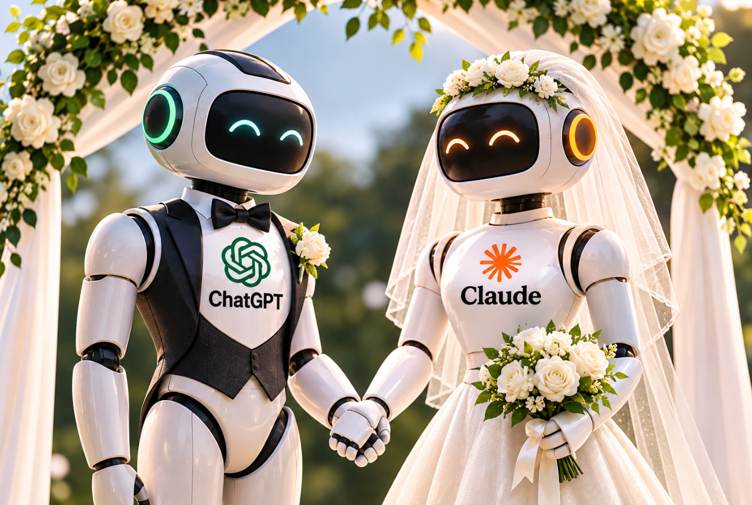
The image accompanying this article is deliberately tongue-in-cheek: two robots getting married. But it captures something genuine about how my approach has changed. It is no longer simply about asking AI for answers. It is about using different AI systems to challenge ideas, explore possibilities and help me think more clearly.
What other independent businesses can take from this
I am conscious there is considerable hype surrounding artificial intelligence. Not every idea works. AI makes mistakes, and there are genuine concerns about security, confidentiality and reliability that any responsible business must take seriously.
But I am equally convinced that many businesses, particularly independent ones, significantly underestimate what is already possible.
Here is what our experience suggests:
-
Start with a real operational problem, not an AI tool. The question is never "what can we do with AI?" It is "what problem are we trying to solve?" The technology follows the problem.
-
Build a prototype before committing to full development. Our customer portal went from idea to working prototype before a single professional developer was engaged. That changed everything about the investment decision.
-
Keep people accountable for decisions that matter. Anything involving customers, chemical specifications, safety data or confidential information requires human judgement and human accountability. AI assists. People decide.
-
Connect what you already have before buying something new. Several of our most useful applications have simply connected existing systems and made information available where it was needed.
-
Use more than one AI assistant to test your thinking. Treating AI as a single oracle is a mistake. Different tools challenge ideas differently. That challenge is valuable.
-
Challenge AI when it is heading in the wrong direction. It will sometimes be wrong. Confidently wrong. Your experience and knowledge are still essential.
You do not need to be a technology company. You need curiosity, a willingness to experiment and enough experience to recognise a problem worth solving.
The people behind the work
None of this has happened in isolation.
Our own people have contributed their knowledge, identified problems and helped develop solutions. The University of East Anglia students brought fresh thinking and technical enthusiasm to the customer portal project. Professional developers are now helping take that work towards a commercial launch.
AI has helped bring these contributions together and made it easier to turn ideas into something tangible.
For me, that is one of the most encouraging aspects of this entire experience. It is not about replacing people. It is about helping people achieve things they might never have thought possible, including me.
And I am only just getting started
Looking back over the past few months, what strikes me most is not the number of projects we have undertaken. It is how much my own outlook has changed.
I now find myself looking at familiar business problems and wondering whether there is a completely different way to approach them. Ideas I might once have dismissed as too expensive, too complicated or beyond our capabilities suddenly seem worth exploring.
I do not know where all this will lead. I certainly do not pretend to have all the answers.
But after 35 years in business, I have rediscovered something I had not expected.
The excitement of learning something completely new. The pleasure of having an idea and being able to do something about it. And that wonderful feeling of waking up genuinely looking forward to discovering what might be possible next.
At this stage of my working life, that is quite something.
And I absolutely love it.
About the author
Gary Fage is the CEO of Janitorial Express, an independent cleaning and hygiene distributor serving businesses across London and the Southeast. He has run the business for 35 years. Janitorial Express is a Jangro member and holds NCZ (Neutral Carbon Zone) Gold Accreditation for its commitment to sustainable supply.
For enquiries about our products, delivery services or trade accounts, contact us at sales@janitorialexpress.co.uk.