How Janitorial Express and NCZ Turned Carbon Reporting into a Commercial Advantage
For many cleaning contractors and FM companies, ESG and Scope 3 reporting has moved from policy documents to very real tender questions are.
Not “Do you have a sustainability policy?”
But:
“Can you evidence the emissions linked to the products supplied to this specific site?”
This is where many suppliers struggle.
At Janitorial Express, we decided several years ago that if clients were going to be asked for this data, we needed to be able to provide it properly.
Not estimates.
Not marketing claims.
Not generic statements.
But data that could be traced back to the actual products purchased.
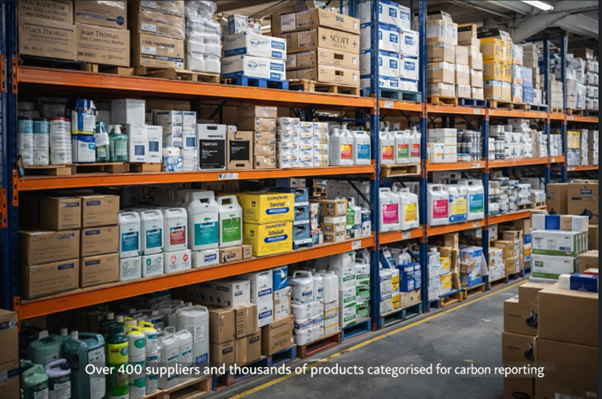
The Challenge: 400+ Suppliers and Thousands of Products
Like most established distributors, our supply chain is complex. We work with more than 400 suppliers and stock thousands of products across paper, chemicals, machinery, consumables and equipment.
The majority of our carbon impact sits in Scope 3, within those products.
Gathering consistent, comparable environmental data from that number of suppliers is not straightforward. In fact, it is one of the most difficult parts of meaningful carbon reporting in our sector.
As part of our work with Neutral Carbon Zone (NCZ), we undertook the task of categorising all products into seven material groups and applying verified carbon metrics to each category.
This allowed us to move from a position of:
“We sell sustainable products”
to:
“We can show you the carbon impact of what you buy from us.”
Why We Chose to Work with Neutral Carbon Zone
We had been on a sustainability journey for many years, but we needed a partner who could translate carbon data into something practical for our business and for our customers.
NCZ provided:
- Practical, responsive support
- Cost-based carbon metrics that could be integrated into our ERP
- A framework that could be turned into real business intelligence, not just reports
The key was being able to link carbon data directly to what flows through our system every day.
Turning ERP Data into Customer Carbon Reports
Working with our IT partners, we extracted this product data from our ERP and transformed it into Power BI reporting.
This allows us to:
- See emissions linked to product categories
- Track purchasing patterns
- Provide customers with reports based on their actual spend and usage
- Identify where the biggest carbon impacts sit
We are now developing this further into a customer portal where clients will be able to access their own carbon footprint data directly through our website, rather than via spreadsheets.

Why Being London-Based is Now a Carbon Advantage
As a London specialist distributor, we have always operated locally.
Historically, this was seen as a service benefit.
Now, it is a measurable carbon benefit.
By optimising routes and progressively transitioning our fleet to electric vehicles through planned lease renewals, we are steadily reducing delivery emissions while maintaining daily service across London.
For clients with London-based sites, this creates a genuine advantage compared to suppliers delivering from outside the capital.
From Sustainability Commitment to Commercial Differentiator
What started as an environmental commitment has become something far more powerful.
The ability to provide verified, product-level carbon data is now helping clients:
- Answer tender questions with confidence
- Evidence Scope 3 emissions at site level
- Choose sustainable products without price penalty
- Demonstrate real progress rather than policy intentions
It has also become a key differentiator for us in retenders and new business opportunities.
Encouraging Greater Transparency from Suppliers
One unexpected outcome of this work has been the positive pressure it has placed on our supplier network.
By asking for better data, we have seen a noticeable shift in how receptive suppliers are to discussing their own environmental impact.
This benefits not just us, but the contractors and FM companies we support.
Making the Sustainable Choice the Easy Choice
A core part of our approach is ensuring that sustainable product options are favourably priced.
Where the cost is the same, choosing the lower-impact option becomes the obvious decision for our customers.
This removes the friction that often slows down ESG progress in operational environments.
What This Means for Cleaning Contractors and FM Companies
If you are being asked to evidence emissions linked to specific sites, this is where we can help.
We can provide:
- Carbon visibility linked to actual purchasing
- Reporting that supports tender submissions
- Data that goes beyond generic sustainability statements
- A local delivery model with a lower associated carbon footprint
Looking Ahead
Our next steps include:
- Launching a customer portal for self-service carbon reporting
- Continuing the transition of our fleet to electric vehicles
- Refining supplier data to ensure greater accuracy and comparability across categories
This is an ongoing process of improvement, not a one-off project.
Download the Full Case Study
If you would like to read the full case study detailing our work with Neutral Carbon Zone and the impact this has had on our business and our customers, you can download it here.
[Download the Janitorial Express & NCZ Case Study]