Four New Electric Vans Join the Janitorial Express Fleet
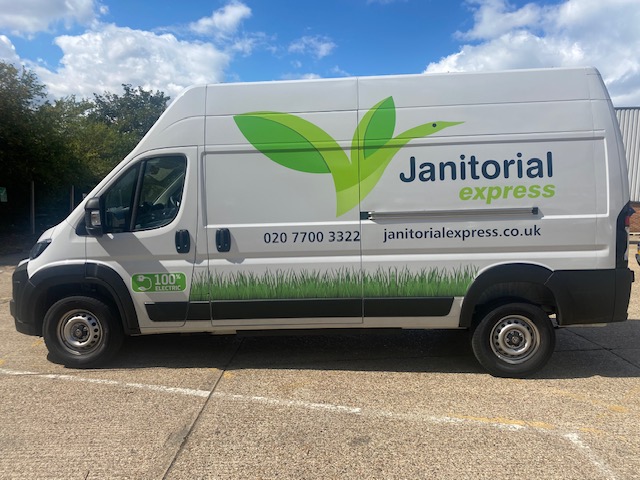
Janitorial Express has added four new 100% electric vans to its delivery fleet, extending its programme of lower-emission deliveries across London and the South East.
The vans are in daily operation, delivering cleaning chemicals, washroom supplies, and janitorial consumables to businesses across the region. Moving these journeys to electric means zero exhaust emissions from those vehicles and a direct reduction in the fleet's reliance on diesel.
Why this matters: for customers who manage their own carbon reporting, the emissions profile of their supply chain is increasingly part of the picture. A supplier that is actively reducing its delivery footprint is a practical contribution to that effort, not just a statement of intent.
The Fleet Investment
The four new electric vans join an existing fleet that operates daily delivery routes out of Janitorial Express's two locations: Unit 44 Hornsey Street in London N7 and the Swanley depot in Kent.
What the vehicles replace
Each electric van takes over routes previously run on diesel. The practical impact is straightforward:
-
Zero tailpipe emissions on every delivery journey those vehicles make
-
Reduced diesel dependency across the overall fleet
-
Measurable progress that can be tracked through mileage and charging data over time
Janitorial Express works with Neutral Carbon Zone (NCZ), the independent carbon measurement body, to measure and report its overall footprint. The company holds NCZ Gold Accreditation. Adding electric vehicles gives the NCZ programme a tangible, trackable area of operational improvement: delivery mileage covered by electric rather than diesel is a clear and verifiable data point.
Why four vans, not a headline target
The decision to add four vehicles reflects the practical reality of fleet transition. Replacing every diesel van at once is not operationally realistic for most businesses. What matters is that each addition is genuine and that progress can be demonstrated over time.
This approach also avoids a common pitfall in sustainability communications: publishing ambitious future targets before the operational infrastructure exists to meet them. The four vans are already running. The emissions reduction is already happening.
Sustainability as an Operational Habit
The electric fleet investment sits within a broader approach to sustainability that Janitorial Express describes as everyday decision-making rather than a separate programme.
Three areas define that approach in practice:
|
Area |
What it means in practice |
|---|---|
|
How we deliver |
Shifting delivery journeys from diesel to electric, reducing exhaust emissions from the fleet |
|
What we recommend |
Stocking and actively promoting eco-certified product ranges, including probiotic and vegetable-based cleaning chemicals |
|
Helping equipment last longer |
Offering commercial cleaning machine repair and servicing so that equipment is repaired rather than replaced |
Each of these is an operational choice made repeatedly, not a one-off commitment. The electric vans make the delivery piece of that visible in a way that customers can see directly: look out for the Janitorial Express logo on your next delivery.
The supply chain dimension
For facilities managers and procurement teams, the sustainability credentials of their cleaning supplies distributor are increasingly relevant to their own reporting. Scope 3 emissions, the indirect emissions that arise across a supply chain, include the transport and delivery of purchased goods.
A distributor that can demonstrate lower-emission delivery routes, and that measures its footprint through an independent body like NCZ, provides a more useful answer to that question than one that offers only a policy statement.
Janitorial Express has published detailed guidance on how FM teams can approach Scope 3 supplier data, including the questions to ask and how to assess the quality of the information received. The electric fleet expansion is part of the evidence base that underpins that conversation.
What We Will Measure Next
Adding electric vans is the start of a measurement conversation, not the end of one. Working with NCZ, Janitorial Express will track progress through the data that matters:
-
Electric mileage vs diesel mileage across the full fleet over time
-
Charging reliability and operational performance of the new vehicles on London and South East routes
-
Emissions avoided as the proportion of electric delivery journeys grows
The intention is to report verified figures through the NCZ framework rather than publish estimates in advance of the data. Credible sustainability communication requires the same discipline as credible Scope 3 reporting: state what is known, be clear about what is still being measured, and improve the evidence base over time.
That is the approach Janitorial Express takes across its environmental work, and the electric fleet is no different.
Find Out More
Customers who want to understand more about the Janitorial Express approach to sustainability, including its NCZ Gold Accreditation, Planet Mark certification, and eco-friendly product ranges, can visit the Our Mission page.
For businesses that want to discuss their supply chain's environmental credentials or request a quote, contact the team at sales@janitorialexpress.co.uk or call 020 7700 3322.
Posted: September 2026 Author: Gary Fage C.Env.Cln, Chief Executive Officer, Janitorial Express